

Minor in Applied Data Science and Analytics
MINOR IN APPLIED DATA SCIENCE & ANALYTICS
Contact
Program Director
Dr. Amy Quarkume
Director, Minor in Applied Data Science & Analytics
✉ datascience@howard.edu
ABOUT THE PROGRAM
The Minor in Applied Data Science is an interdisciplinary program housed in the Department of Interdisciplinary Studies within the College of Arts and Sciences. Designed to complement a wide range of majors, the program builds foundational and applied skills in data analysis, interpretation, visualization, and ethical inquiry. Students work with real-world challenges through a social impact lens and gain experience with widely used tools such as Python, R, and data storytelling platforms.
Grounded in Howard University’s commitment to Truth and Service, the minor supports students who want to address societal challenges, strengthen their research skills, or prepare for data-informed careers. It provides practical, interdisciplinary training for a data-driven world and emphasizes ethical inquiry and responsible data use in examining local, national, and global issues.
The Applied Data Science minor is open to all Howard University undergraduate students across all majors. Students should consult with their academic advisor to ensure the minor complements their primary degree program.
The Minor in Applied Data Science prepares students to work confidently with data in a rapidly evolving, data-driven world. The program builds a strong interdisciplinary foundation, develops practical analytical and computational skills, and emphasizes ethical and real-world approaches to data use. Graduates will be equipped to apply data science methods across fields, support evidence-based decision-making, and pursue data-enabled careers and advanced study.
W.E.B. Du Bois, The Philadelphia Negro, 1898
Nevertheless here are social problems before us demanding careful study, questions awaiting satisfactory answers. We must study, we must investigate, we must attempt to solve ; and the utmost that the world can demand is, not lack of human interest and moral conviction, but rather the heart-quality of fairness, and an earnest desire for the truth despite its possible unpleasantness.
Why Choose the Minor in Applied Data Science?

Versatility
Apply data science skills across health, business, science, policy, social sciences, and the humanities.
Skills
Build practical competencies in programming, statistics, data analysis, visualization, and data storytelling

Ethics
Evaluate data and technology using ethical, responsible, and socially informed approaches.

Careers
Develop data competencies relevant to a growing range of professional and data-enabled careers
Research
Strengthen your ability to collect, analyze, interpret, and communicate data for academic and applied research

Impact
Use data to investigate real-world problems and develop evidence-based solutions to societal challenges
Expected Learning Outcomes
Students completing the Minor in Applied Data Science will be able to:
- Mathematics & Statistics: Apply statistical methods and quantitative reasoning to analyze, interpret, and draw conclusions from data.
- Programming: Use programming tools such as Python, R, and SQL to collect, clean, analyze, and troubleshoot data workflows.
- Modeling: Design, evaluate, and interpret data-based models to address real-world questions.
- Data Curation: Acquire, clean, prepare, document, archive, and manage data from multiple sources across the data lifecycle.
- Ethics: Assess data practices and analytical decisions through ethical, responsible, and social-impact frameworks, including considerations relevant to the African diaspora.
- Communication: Communicate findings through visualization, data storytelling, and written and oral presentation for a range of stakeholders.
Curriculum Requirements
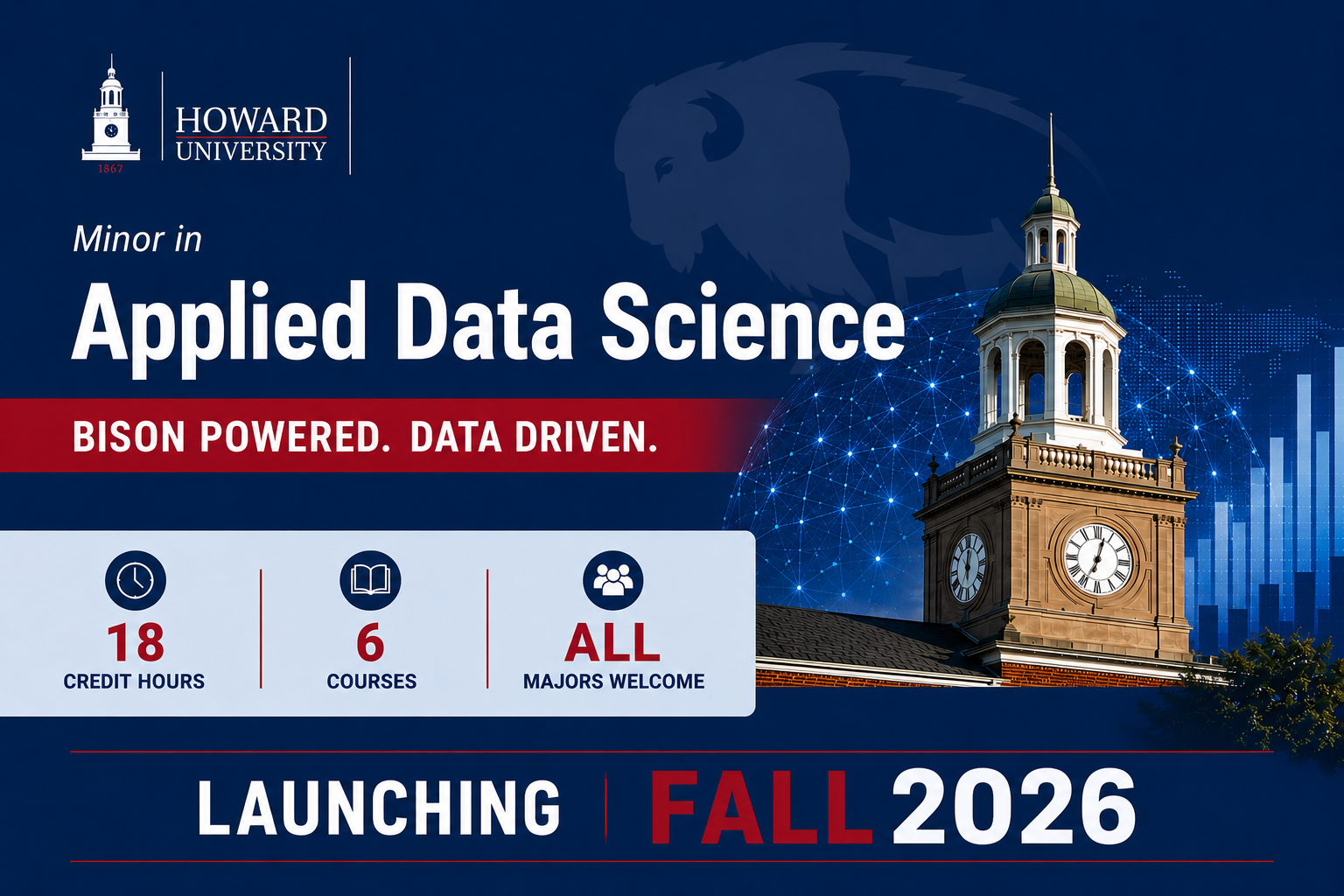
The Minor in Applied Data Science is an 18-credit (6 courses), interdisciplinary program at Howard University open to undergraduates across all majors. Students complete six courses spanning foundational skills in statistics and Python, ethics-centered data practice, and advanced applied methods. The curriculum is grounded in Howard's commitment to Truth and Service, centering equity, the African diaspora, and real-world social impact. Graduates emerge career-ready with technical fluency and the values to direct data toward the communities that need it most.
Course Substitutions
Students may request a course substitution through a formal appeal process. All substitutions must be reviewed and approved by the program coordinator.
View Here
Career Opportunities with Applied Data Science
Applied data science skills are in high demand across every sector. The U.S. Bureau of Labor Statistics projects 35% growth in data scientist roles from 2022–2032 (BLS), and PwC reports that 30–50% of new jobs require data and analytics capabilities (PwC). The Minor in Applied Data Science enhances any major by adding essential skills in data analysis, programming, visualization, modeling, and ethical data use.
There are many examples of data-enabled positions, and here are just a few.
- Business & Operations: Data Analyst, Business Intelligence Analyst, Operations Analyst, Financial Analyst, Risk Analyst
- Health, Science & Environment: Healthcare Data Analyst, Clinical or Public Health, Research Analyst, Environmental Data Analyst, Quality Assurance Analyst
- Policy, Social Impact & Nonprofit: Policy Analyst, Program Evaluator,Social Impact Researcher, Nonprofit Data Coordinator
- Marketing, Communication & Media: Marketing Analyst, Customer Insights Analyst, Social Media Analyst, Data Storytelling and Visualization Specialist
- Technology, Product & Innovation: Product Analyst, Supply Chain Analyst, Research Analyst, UX/Data Research Assistant
- Advanced Career Paths (with additional experience or education): Data Scientist, Data Engineer, Machine Learning Engineer, Database Administrator, Data Architect
Because this minor is designed to complement any major, students can apply data skills directly within their discipline, whether in science, business, policy, communication, health, the arts, or engineering. Data fluency strengthens applications for internships, graduate programs, and full-time roles by demonstrating the ability to interpret information, solve problems, and make evidence-based decisions.
Contact Us
Amy Yeboah Quarkume, Ph.D. (she/her)
Director of the Minor in Applied Data Science & Analytics Program
College of Arts and Sciences
DataScience@howard.edu